Van Life Mobile Power Setup Reviews: Simple Energy for Peaceful Travels (2026)

Updated: 6 days ago
What if your van's electrical system felt less like a high-stakes science experiment and more like the quiet hum of a cozy living room? Many travelers start their journey overwhelmed by the confusing math of volts and amps, or paralyzed by the thought of complex wiring and fire risks. It's completely normal to feel a sense of anxiety when you're miles from the nearest outlet, wondering if your batteries will hold through the night. This guide provides the most honest van life mobile power setup reviews for 2026, focusing on systems that prioritize your peace of mind over technical complexity.
Want a simple starting point for van power? Grab my free UK Camper's Power Guide from the sign-up form at the bottom of the Life Gear Lab homepage.
This deep dive into van life portable power setup UK covers everything from sizing a battery bank to choosing solar panels, written for anyone building a van from scratch in 2026.
You'll discover how the latest all-in-one portable power stations have replaced noisy, high-maintenance generators with silent, solar-ready alternatives. We've filtered through the market to find the most reliable gear that meets modern safety standards like UL 458, ensuring your home on wheels stays safe and powered. We'll walk you through the top-rated kits for 2026, comparing everything from compact units for weekenders to high-capacity systems capable of running a full kitchen. By the end of these field-tested notes, you'll have a clear, stress-free path to choosing a power setup that lets you focus on the view outside your window rather than the wires under your bed.
Table of Contents
The Philosophy of Mobile Power: Why Your Setup Defines Your Van Life Peace
Mobile power is the silent heartbeat of a modern van. It shouldn't be a source of constant technical stress or a puzzle you're forced to solve in the middle of a remote forest. Instead, we view an energy system as a vital tool for domestic comfort. It's the fundamental difference between "surviving" the night and actually feeling at home. When you move past the anxiety of checking battery levels every hour, you enter a state of trust. A reliable setup provides a predictable, safe foundation for your life on the road, allowing you to relax into your surroundings.
Silence is the ultimate luxury in nature. While traditional gas generators provide power, they also bring noise, fumes, and maintenance chores that break the very peace you traveled to find. Modern systems focus on quiet reliability. By looking at van life mobile power setup reviews, you'll see a distinct shift toward these tranquil, battery-based solutions. A smaller, highly efficient system often provides more freedom than a bulky, oversized one that weighs down your vehicle and your mind. Our goal is to help you find that "sweet spot" where your gear serves your lifestyle without demanding all your attention.
The Transition from Off-Grid to 'Connected Calm'
Reliable energy removes the heavy mental load that often accompanies nomadic living. You stop worrying about whether your laptop will die during a critical meeting or if the fridge will stay cold through a heatwave. We treat technology like Starlink, laptops, and smartphones as natural parts of a modern outdoor experience rather than distractions from it. A mobile power setup acts as the essential bridge between the restorative power of nature and the practical necessities of modern life.
Assessing Your True Energy Needs
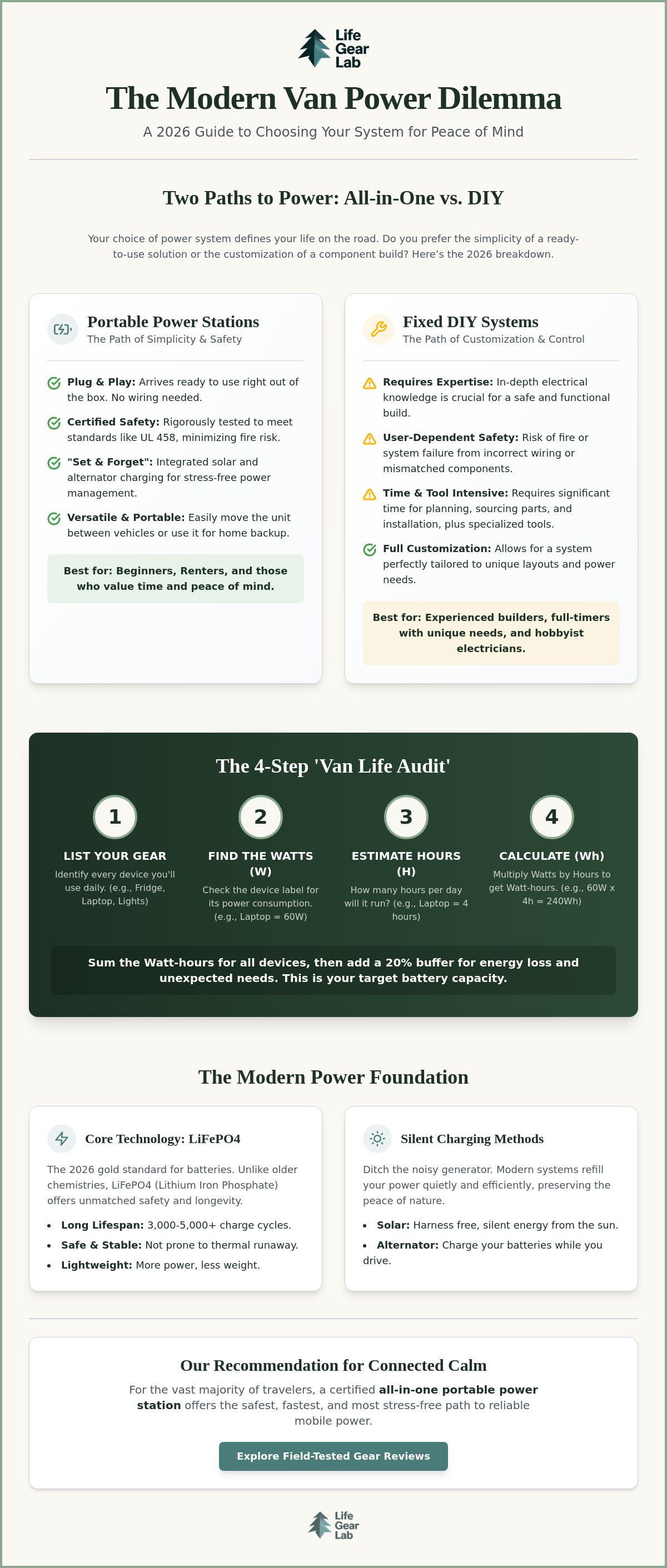
Before choosing a system, perform a "Van Life Audit." List your non-negotiable comforts, such as a 12V fridge or a heater fan, versus your occasional luxuries like a blender or a hair dryer. Many beginners fall into the trap of buying massive capacity they'll never use, leading to wasted space and unnecessary costs. When you study van life mobile power setup reviews, focus on how much energy you actually consume in a 24-hour period rather than just looking at the biggest battery available.
Understanding how photovoltaic systems work helps you realize that your battery is simply a reservoir; you only need a reservoir large enough to hold what you pour out each day. To calculate your needs without a math headache, follow this simple framework:
Identify the Watts: Look at the sticker on your device (e.g., a 60W laptop charger).
Estimate the Hours: Decide how long you'll use it daily (e.g., 4 hours).
Find the Total: Multiply them together (60W x 4 hours = 240 Watt-hours).
Add a Buffer: Add 20% to account for "vampire loads" and efficiency losses.
This methodical approach ensures you build a kit that is intentional, lightweight, and perfectly suited to your personal sense of calm.
Portable Power Stations vs. Fixed DIY Systems: Choosing Your Path
Choosing how to power your mobile home is a decision about how you want to spend your time. Do you want to be an electrician, or do you want to be a traveler? For many, the "All-in-One" appeal of portable power stations, often called SoGens, has become the gold standard for 2026. These units offer a tranquil start to the journey. They arrive ready to work. There is no anxiety over loose connections or mismatched components because every part is engineered to work in harmony. When reading van life mobile power setup reviews, it becomes clear that for those who value safety and simplicity, these pre-built units are the most welcoming path.
The "Buy Better, Buy Less" philosophy applies heavily here. While a high-quality portable unit requires a larger upfront investment, it removes the hidden costs of specialized tools, fuses, and heavy-gauge wiring required for a custom build. For the non-electrician, this is the ultimate form of fire safety and peace of mind. You aren't just buying a battery; you're buying a certified system that has undergone rigorous testing to meet modern safety standards.
The Case for Portable Power Stations
The primary benefit is the zero-install nature of the equipment. You can move your power plant from the van to a campsite picnic table or use it as a home backup during the off-season. Because these units include a built-in Battery Management System (BMS), they provide standardized protection against overcharging and heat. This level of safety is hard to replicate in a DIY build without significant expertise. High-quality portable units also hold their resale value well. If you decide to upgrade your vehicle, your power source simply moves with you. For a deeper look at specific equipment, our Field-Tested Gear Reviews provide a clear perspective on which units truly survive the rigors of the road.
When to Consider a Fixed DIY Setup
There is a specific threshold where the complexity of components from brands like Victron or Renogy becomes a logical choice. This usually happens when you cross into the "Digital Nomad" territory. If you are running high-draw appliances like induction cooktops or air conditioners around the clock, a standard 2000Wh portable unit might feel restrictive. Fixed systems allow for massive expansion. You can hide the batteries in custom cabinetry to save floor space and hardwire every outlet for a seamless look.
The trade-off is the mental and physical toll of the installation. You will likely spend weeks researching wiring diagrams and crimping heavy lugs. While the hardware costs might be lower, the "cost" in stress and time is significant. For most travelers, the "set it and forget it" dream is more easily achieved with a high-capacity portable station. Modern van life mobile power setup reviews show that today's portable units now offer the same alternator integration that used to be exclusive to custom builds, bridging the gap between convenience and performance.
Field-Tested Reviews: The Best Mobile Power Setups of 2026
At Life Gear Lab, we believe gear should be invisible. It should support your journey without demanding your constant attention. To find the most reliable options, we subjected the leading units to 12 months of rigorous field testing across diverse climates and terrains. This durability report focuses on how these systems handle the humidity of the coast and the dust of the desert. Our van life mobile power setup reviews prioritize the lived experience, looking for the "coziness factor" that technical spec sheets often overlook.
We've confirmed that the industry-wide transition to Lithium Iron Phosphate (LiFePO4) chemistry is the most significant safety improvement for 2026. These batteries offer 3,000 to 4,000 charge cycles, providing a stable foundation that lasts for years. Every unit we recommend also meets essential safety standards like UL 458, ensuring your mobile home remains a sanctuary rather than a hazard.
Top-Rated Compact Units for Simple Living
The "Minimalist's Choice" is defined by portability and tranquil operation. For weekenders and solo travelers, the Bluetti EB70S ($429) and the Jackery Explorer 1000 v2 ($399.99) are standout performers. These units excel at low-draw efficiency. They keep your LED lights glowing and your 12V fridge humming without wasting energy on loud, aggressive cooling fans. We recommend these for day-trippers and SUV campers who value a small footprint. During our testing, the Jackery unit was particularly impressive for its near-silent fan profile, which is vital for a peaceful night's sleep in a small space.
High-Capacity Powerhouses for Remote Work
If you're balancing a career with the road, you need a "Digital Nomad's Workhorse." These 2000Wh+ units, such as the Bluetti AC200L ($1,099) and the Anker SOLIX F2000 ($899), are designed to handle high-output appliances like induction cooktops and 4K monitors. A Pure Sine Wave inverter is non-negotiable here. It provides the clean, stable power required to protect your expensive laptops and cameras from electrical noise.
Charging speed is another critical factor for remote workers. The Anker SOLIX C2000 Gen 2 ($849.00) can charge from 0-80% in under an hour via a standard wall outlet. This allows you to top off your "power plant" during a quick coffee shop stop. When you're away from the grid, these units support high solar input, turning a sunny afternoon into a full day of productivity. If you use that time to build web apps, the LAST ZONE extension offers a great way to enhance your experience with Lovable. For those seeking the "Full-Timer’s Foundation," the EcoFlow DELTA Pro ($1,499) offers an expandable ecosystem. You can start with a single unit and add extra batteries as your lifestyle grows, ensuring you never outgrow your initial investment.
Silent Charging: How to Refill Your Power Without the Stress
Refilling your energy reservoir shouldn't feel like a chore that interrupts your peace. In our van life mobile power setup reviews, we've found that the most tranquil travelers are those who diversify their charging sources. By using a combination of solar, alternator, and shore power, you create a resilient system that works in the background. This "invisible" energy cycle allows you to focus on the landscape rather than a battery monitor. Whether you're parked under a desert sun or driving through a coastal storm, your setup should quietly gather what it needs.
Solar power remains the gold standard for parked serenity. It is a completely silent, "set and forget" energy source that respects the stillness of your surroundings. While solar is vital, alternator charging is often the most efficient way to refill a large battery bank. Driving for just two hours can often provide more energy than a full day of sun. For rainy weeks or urban stays, shore power acts as a necessary safety net, allowing you to top off your system at a friend's house or a campsite. Balancing these inputs helps manage "energy anxiety," the nagging fear of running out of power. We recommend checking your levels once in the morning and once at night; anything more is often unnecessary obsessing.
Portable vs. Fixed Solar Panels
Choosing between portable and fixed panels depends on your preferred camping style. Portable panels offer the freedom to park your van in the cool shade while placing the panels in the direct sun. This keeps your living space comfortable while your "power plant" works elsewhere. Fixed panels are the choice for a low-stress life. They gather energy while you drive and while you sleep, requiring zero setup time. An MPPT (Maximum Power Point Tracking) controller acts as the smart brain of your system, constantly adjusting to squeeze every possible Watt from the sun's rays. To see which panels survived our long-term testing, explore our Van Life & Tech Guides for a detailed look at the best charging kits.
Maximizing Your Alternator's Potential
Modern vehicles in 2026 often feature "smart alternators" that vary their voltage to save fuel. This makes a dedicated DC-to-DC charger essential. Unlike a simple 12V plug-and-play cable, a DC-to-DC charger ensures your house battery receives a steady, optimal flow of energy without overstressing the vehicle's electrical system. Safety is the priority here. A properly installed charger includes a voltage-sensitive relay or an ignition trigger to ensure you never accidentally drain your starter battery. This "safety first" rule ensures that even if you use all your domestic power, your van will always be ready to start when the horizon calls. In our van life mobile power setup reviews, we consistently highlight systems that include these protections as the most reliable for long-term travel.
Building Your Starter Power Kit: The Life Gear Lab Recommendation
Choosing the right components for your first journey is an exercise in intentionality. We advocate for the "Buy Once, Cry Once" philosophy. This means investing in high-quality Lithium Iron Phosphate (LiFePO4) batteries from the start. While the initial cost is higher than older lead-acid alternatives, the long-term value is undeniable. These batteries provide over 3,000 charge cycles and maintain a steady voltage until they are nearly empty. In our van life mobile power setup reviews, we consistently find that travelers who prioritize battery quality enjoy a much higher level of psychological safety. They aren't constantly wondering if their system will fail in the middle of a cold night.
Accessories often get overlooked, but they are the veins of your electrical system. Gauge matters for safety. Using thin, cheap extension cords for high-draw appliances can lead to overheating and fire risks. Always opt for heavy-duty, outdoor-rated cords. To maximize efficiency, look for power stations with USB-C PD (Power Delivery) ports. This allows you to charge your laptop directly from the battery. By bypassing the inverter, you save roughly 15% of your energy that would otherwise be lost to heat. Small choices like this extend your off-grid time significantly.
Curating Your Essential Power Accessories
A well-curated kit focuses on both utility and ambiance. We recommend adding simple LED lighting kits that emit a warm, 2700K glow. This creates a "home-like" atmosphere that harsh, blue-tinted lights can't match. Your power system should also support a "Coziness Corner." Whether it's a small electric blanket for chilly mornings or a low-wattage kettle for tea, these small comforts make a van feel like a sanctuary. When you read van life mobile power setup reviews, look for units that offer multiple DC ports to keep these accessories running without needing bulky AC adapters.
The Life Gear Lab 'Peace of Mind' Guarantee
We believe in a "slow start" approach. You don't need a massive, expensive system to enjoy the road immediately. Start with a compact kit that meets your basic needs, then expand as you learn your true consumption patterns. We prioritize brands that offer 5-year warranties and accessible human support. This ensures that if something does go wrong, you aren't left stranded. See our full 'The Calm Van Life' gear guide for more minimalist essentials to help you build a setup that prioritizes tranquility over technical clutter.
First Night Off-Grid Checklist:
Confirm your power station is charged to 100% before departure.
Test your 12V fridge connection to ensure it stays seated during travel.
Verify you have the correct solar adapter for your specific panel brand.
Pack at least one heavy-duty extension cord for emergency shore power.
Check that all cables are tucked away to prevent tripping in small spaces.
Embrace the Stillness of Reliable Power
Your journey into van life should be defined by the landscapes you visit, not the wires under your seat. We've seen how choosing an all-in-one portable power station can replace technical anxiety with domestic comfort. By prioritizing high-quality LiFePO4 battery chemistry and silent, "set and forget" charging methods, you create a foundation of safety that lasts for years. Energy should be easy. These choices allow your mobile home to remain a sanctuary where technology supports your lifestyle rather than distracting from it.
Our van life mobile power setup reviews are the result of 12+ months of dedicated off-grid field testing. While our work is affiliate-supported, we remain editorially independent to ensure our focus stays on beginner-friendly, zero-stress setups that actually work. We've already performed the exhausting work of filtering through the noise so you can start your adventure with confidence and clarity.
Ready to take the first step toward a more tranquil road trip? Build your perfect mobile power kit with our field-tested recommendations. The horizon is waiting for you, and with the right energy setup, you'll have everything you need to enjoy it in total peace.
Common Questions About Mobile Power
How many watts do I really need for van life?
Most solo travelers find that 1000Wh to 2000Wh is the ideal capacity for domestic comfort. This provides enough energy to run a 12V fridge, charge a laptop, and keep LED lights glowing for two to three days without a recharge. If you plan on using high-draw appliances like induction cooktops, aim for the higher end of that range. Finding this balance prevents you from carrying unnecessary weight while ensuring your peace of mind remains intact.
Can I run a heater or AC off a portable power station?
You can run high-draw climate control appliances, but only for limited durations unless you have a massive expandable system. A standard 2000Wh unit might only power a portable AC for two to four hours. For heat, we recommend using the power station for an electric blanket instead, which uses significantly less energy than a space heater. This approach keeps you cozy through the night without draining your entire reservoir before the sun rises.
Is it safe to charge my power station while I'm sleeping in the van?
It is perfectly safe to charge modern units while you sleep, provided they meet safety standards like UL 458. These systems feature an integrated Battery Management System (BMS) that monitors temperature and prevents overcharging. To maintain a tranquil environment, look for units with a "silent" or "low-speed" charging mode to keep fan noise at a minimum. This ensures you wake up with a full battery and a well-rested mind.
How long do LiFePO4 batteries actually last in a van environment?
LiFePO4 batteries typically last between 10 and 15 years, even with daily use on the road. Most high-quality units are rated for 3,000 to 4,000 charge cycles before their capacity drops to 80% of the original total. This longevity makes them the most reliable choice for long-term travelers. Because they handle the vibrations and temperature fluctuations of a van environment so well, they provide a stable foundation for your mobile lifestyle.
What is the difference between a solar generator and a portable power station?
There is technically no difference; these terms are used interchangeably in most van life mobile power setup reviews. A "solar generator" is simply a marketing term for a portable power station that includes solar panels in the bundle. Both devices combine a battery, an inverter, and a charge controller into one "all-in-one" box. This integrated design is what makes them so welcoming for beginners who want to avoid the complexity of custom wiring.
Do I need to hire an electrician to install a power setup in my van?
You don't need an electrician if you choose a portable power station, as these are "plug-and-play" systems. They are designed to be safe and functional right out of the box with no specialized tools required. However, if you decide to build a custom, high-voltage fixed system with complex busbars and multiple components, consulting a professional is a wise safety precaution. For most travelers, the portable route offers the simplest path to a safe home.
Can I charge my van's power setup while I'm driving?
You can easily charge your setup while driving by using your vehicle's 12V accessory port or a dedicated DC-to-DC charger. This is often the most efficient way to refill your battery, as the vehicle's alternator produces a steady flow of energy while the engine runs. Many modern van life mobile power setup reviews highlight units that can accept high-wattage DC input, allowing you to top off your system significantly faster than solar alone could manage.
How do I protect my power station from extreme heat or cold?
Protect your system by keeping it in an insulated, ventilated area of your van away from direct sunlight. Most batteries have a safe operating range between 32°F and 113°F. If you're traveling in freezing climates, look for units with "self-heating" functions or keep the power station in the main cabin where you run your heater. This simple care ensures the internal chemistry remains stable and your power stays reliable regardless of the weather outside.
For the latest EcoFlow launch, see our post on the EcoFlow STREAM 5000 UK — a next-generation power station worth knowing about before your next van build.


Comments